Activities
協議会の活動
Activity purposePurpose
Leading Japan Towards Circular Economy Excellence
This Council promotes activities focused on the following three pillars. Through collaboration with diverse stakeholders in the resource circulation sector—including manufacturers, retailers, waste generators, collection and transportation providers, recyclers, financial institutions, local governments, experts, ministries, and related organizations—we engage in "Policy Recommendations," "Social Demonstration and Implementation," and "Information Sharing and Dissemination."
・「Resource circulation that links the "arterial" and "venous" industries of the supply chain, possessing high environmental value and international competitiveness.」
・「Value creation in green innovation through the utilization of DX (Digital Transformation) technologies and carbon circulation.」
・「Creation of decarbonized, low-environmental-impact regional circulation models through the formation of "Regional Circular and Ecological Spheres."」
Themes that the council focuses on
Three Pillars and Their Foundational Development
Resource recycling in which the upstream and downstream sectors of the supply chain, possessing high environmental value and international competitiveness, work in coordination
Leveraging DX technology to create value through carbon recycling-based green innovation
Creation of a decarbonized, low-environmental-impact regional circulation model through the formation of a regional circulation co-existence sphere
Rule-making to foster the creation of new markets
Behavioral change in businesses and consumers, and the fostering of new values
Information disseminationCommunications
In addition to regularly hosting events that facilitate business matching among members, we will hold seminars to share leading domestic and international examples of resource recycling and, through newsletters (for members) and owned media, conduct wide communications of the council’s activities.
Events & Seminars
- Presentations of working group activities
- PR and exhibition by member companies and organizations
- Networking events (business matching, social gatherings)
- Seminars (lectures, panel discussions, etc.) that share domestic and international examples of circular economy initiatives
Newsletter (for members) / Owned Media
- We regularly distribute information such as reports on the council’s activities, various information about the circular economy, introductions of initiatives by Regular Member and Supporting Member companies, and awareness-raising content for the broader society.
ProjectsProject
Management of Theme-Specific Projects
Starting in fiscal 2026, we will set "specific themes in resource and carbon circulation" (such as policy recommendations, institutional design, and implementation challenges) to further accelerate policy proposals and social demonstration/implementation, while addressing the diversifying points of contention in GX (Green Transformation) promotion strategies. We will advance discussions on policy planning and institutional design through a project-based format.
*Members for each project are appointed by the Secretariat, based on the specific theme and the planned operational methods.
Furthermore, the Secretariat may request cooperation with surveys regarding "specific themes in resource and carbon circulation" (such as policy recommendations, institutional design, and implementation challenges) from Endorsing Members, Supporting Members, Startup Members, and sponsoring or observer companies/organizations.
*Regarding projects on individual themes of resource and carbon circulation, opportunities to participate will be provided for Supporting Members, Regular Members, and Special Members. However, this restriction does not apply to members nominated by the secretariat.
Project List
Project 1
Drafting of Japanese Industrial Standards (JIS) for "CCU Calcium Carbonate" and "CCU Calcium Carbonate-Plastic Composite Materials"
Project 2
Solving Overtourism-Related Environmental Issues & Building Resource Circulation Models
Project 3
Coming Soon
Project 1
Drafting of Japanese Industrial Standards (JIS) for "CCU Calcium Carbonate" and "CCU Calcium Carbonate-Plastic Composite Materials"
Background & Objectives
Amid the growing global importance of GHG reduction and carbon management, Japan is driven by its "Sectoral Investment Strategies for Green Transformation (GX)" to promote target-specific investment and market creation. For the chemical sector, the government has outlined a policy to "reinvest funds earned from functional chemicals into decarbonization and low-carbon investments for basic chemicals, while simultaneously creating demand by ensuring the visibility of GX value." Consequently, there is an urgent need to drive initiatives focused on decarbonization and low-carbon transitions.
Among the various CCUS pathways, CCU is a highly rational approach in Japan because it utilizes captured CO₂ as a valuable resource. In particular, carbonation is a technology that sequesters CO₂ as a thermodynamically stable mineral. Unlike converting CO₂ into fuels or chemicals, this pathway is less prone to re-releasing the captured gas, giving it a distinct operational advantage as a method for long-term carbon sequestration.
Among these, CCU calcium carbonate offers long-term stability in CO₂ sequestration, seamless integration with the existing calcium carbonate market, and high compatibility with domestic resource circulation. Furthermore, it is ideally suited for applications requiring long-term use, such as concrete and building materials. Consequently, companies are actively driving its implementation as a strategic and practical solution that advances Green Transformation (GX).
On the other hand, CCU calcium carbonate is visually indistinguishable from conventional products, and no framework currently exists to verify that the carbon it contains is derived from CCU. Consequently, even when individual companies explain their products based on their own proprietary standards, it remains difficult for customers to evaluate them. Despite the supply and demand alignment, the lack of a standardized assessment framework remains a significant bottleneck to market creation.
With the participation of key stakeholders, experts, and industry operators involved in the production and utilization of materials, this Committee aims to solve these challenges by establishing Japanese Industrial Standards (JIS). These standards will define verification methods for CCU origin, as well as objective evaluation and labeling guidelines for CO₂ sequestration. Ultimately, our objective is to position CCU calcium carbonate as a high-value-added, trustworthy material.
*Source: Cabinet Secretariat, Growth Strategy Council (4th Meeting), "Reference Document 1: 'Key Products, Technologies, etc.' in the 17 Strategic Sectors"
https://www.cas.go.jp/jp/seisaku/nipponseichosenryaku/kaigi/dai4/gijishidai.html
Activities
Under this project, we will manage the "JIS Draft Development Committee" toward successful standardization. This committee serves as a deliberative body established to prepare drafts for proposing standards to the competent minister, pursuant to Article 12 of the Industrial Standardization Act. Within the committee, manufacturers, consumers, and neutral parties will exchange perspectives from their respective standpoints, ensuring a highly specialized, fair, and impartial process for reviewing and developing the draft standards.
The Committee will primarily review and develop the following items:
- 1. Scope, Definitions, and Classifications of the Standard
- 2. Verification Methods for CCU Attributes in CCU Calcium Carbonate and Its Plastic Composite Materials
- 3. Quantification Methods for Seestered CO₂ Volume
- 4. Labeling and Marking Methods
Project 2
Solving Overtourism-Related Environmental Issues & Building Resource Circulation Models
Background & Objectives
As the global shift toward sustainable tourism accelerates, Japan has also designated the promotion of a tourism-oriented nation and coexistence with local communities and the natural environment as key policies. However, driven by the rapid expansion of domestic and international tourism demand, overtourism has triggered critical social issues—most notably waste management problems at tourist destinations, including increased littering, degraded landscapes, and a shortage of inbound-ready infrastructure.
The "Tourism-Oriented Nation Promotion Basic Plan"* also highlights key measures such as the deployment of smart trash bins and the raising of visitor awareness prior to travel ("Tabi-mae"). Consequently, there is an urgent need to move beyond transient cleanup activities or the installation and collection of conventional trash bins. Instead, establishing a new waste collection infrastructure and implementing continuous public awareness campaigns have become paramount.
Led by Mr. Junsei Kido, a Special Member of our Council, this project will leverage the model case of "BinGo," a mobile trash bin advertising service provided by WASABI Inc. Through this initiative, we will drive litter reduction at tourist destinations and large-scale events nationwide, while simultaneously promoting public awareness campaigns among tourists and attendees.
Based on preceding case studies conducted in areas such as Shibuya, Tokyo, this project will evaluate the feasibility and demands for expanding "BinGo" to other prefectures and large-scale events. By collaborating with local governments, we aim to establish a repeatable framework, ultimately developing a "highly scalable and standardized package model" that can be rolled out nationwide to drive successful social implementation.
*Source: Japan Tourism Agency (JTA), Ministry of Land, Infrastructure, Transport and Tourism (MLIT)
https://www.mlit.go.jp/kankocho/seisaku_seido/kihonkeikaku.html
Activities
Under this project, we will deliberate and review strategies to build a sustainable and scalable framework. The Committee will primarily focus on reviewing and developing the following items:
- 1. Establishing a Model for Continuous Nationwide Expansion Through "Community-Building"
- 2. Reviewing Post-Collection Waste Management Challenges and Optimizing Resource Circulation Models
- 3. Developing the "Cross-Prefecture Expansion Package" and Launching Full-Scale Nationwide Rollout
If you would like to propose a partnership or learn more about this project, please contact us using the form below.
https://docs.google.com/forms/d/e/1FAIpQLSckwdrO8VA8PYt6s83cDRje1b3Gn23GjnjzXkhKd3Yf8qjkVA/viewformPast Working GroupsWorking Group
Aiming at the collaboration of the dynamic and static industries throughout the life cycle, the value creation of green innovation utilizing DX technology, and the creation of a regional circulation model, the “regular members” and “special members” who promote the circular economy and the secretariat will not only collaborate on information and mutual understanding, but will also work together in working groups to create a regional circulation model, We will not only collaborate on information and mutual understanding, but also output each initiative to society.
*As a rule, only Regular Member and Special Member can participate in the working group. startup members can participate in working groups intended for startup companies, organizations, entrepreneurs, and management teams. The secretariat will select members of each working group, taking into account the theme and number of participants. In addition, for Approval Member, Supporting Member, startup member, as well as sponsor/Observer companies and organizations, board of directors and the secretariat may request cooperation in surveys related to the council’s activities or request (on a voluntary basis) their participation in working groups attended by Regular Member and Special Member.
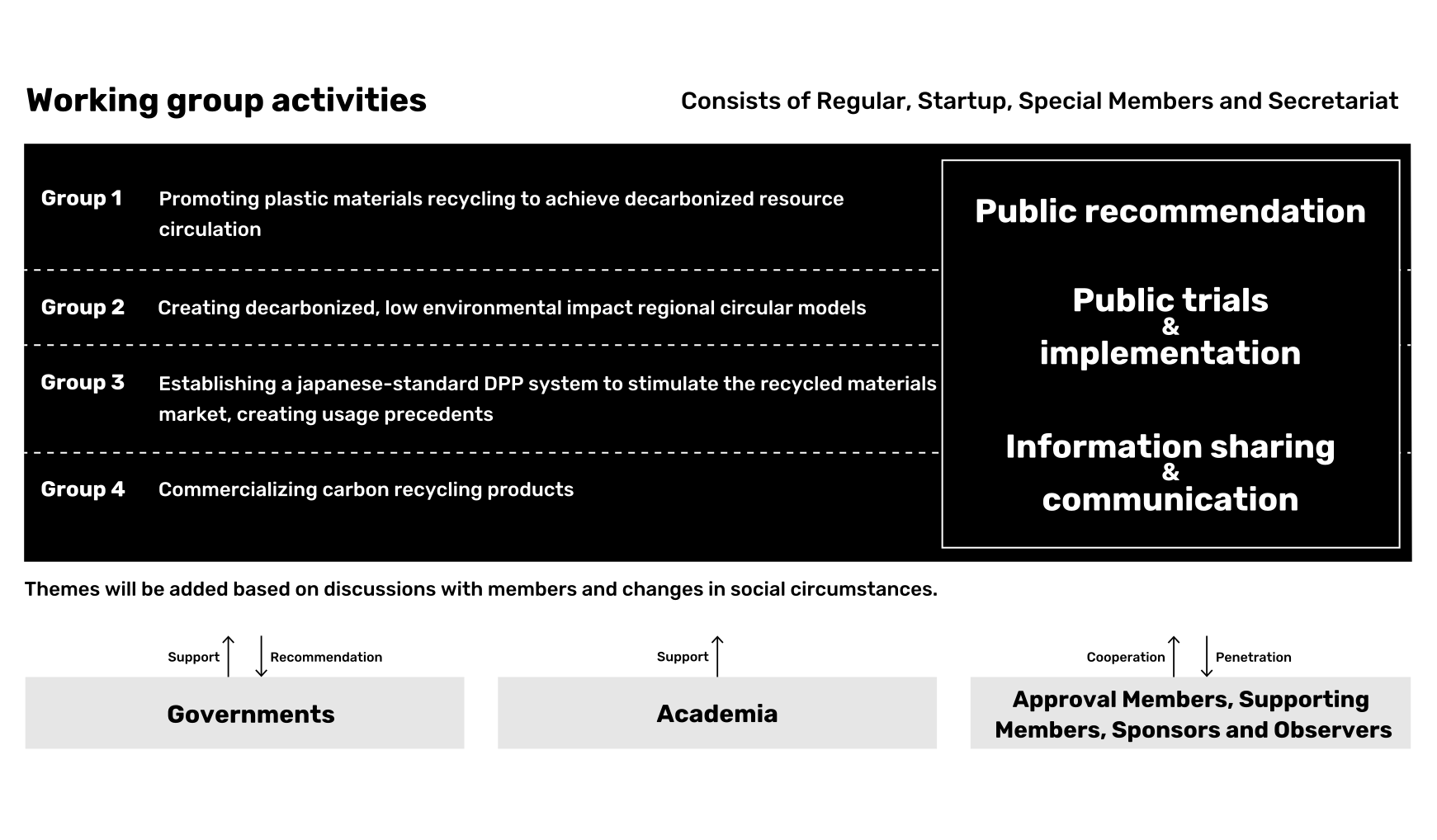
Group 1
Promotion of material recycling of plastics to realize decarbonized resource circulation
Purpose
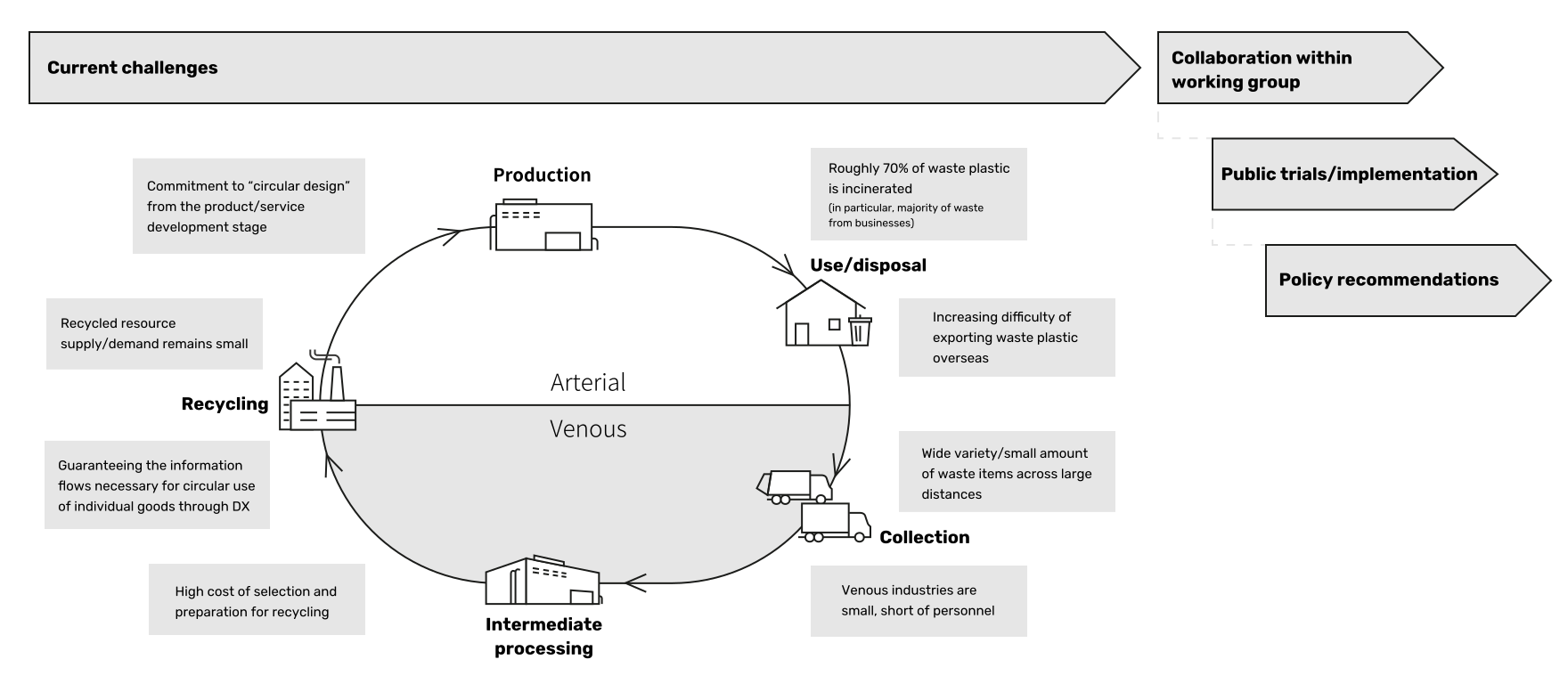
To achieve the 2030 milestone of doubling recycling, as stated in the Plastic Resource Circulation Strategy, and to promote collaboration between upstream and downstream industries, we will conduct Policy Making and social implementation to build a decarbonized plastic resource circulation system.
*We will conduct Policy Making on the “Bill to Advance the Sophistication of Recycling Businesses, etc., for the Promotion of Resource Circulation.”
Activities
According to the Ministry of the Environment’s summary of the “Second Review of the Fourth Fundamental Plan for Establishing a Sound Material-Cycle Society and Formulation of the Circular Economy Roadmap,” the volume of collected plastic containers, packaging, and plastic products is projected to more than double by 2030, and the volume of voluntary collection by companies and collection of plastic industrial waste is estimated to increase by about one million tons.
In this working group, to achieve our objectives, we will organize the issues currently considered to be challenges in building a decarbonized plastic resource circulation system, as identified by various stakeholders involved in resource circulation who participate as working group members. We will conduct a survey (to re-identify, reconfirm, and solicit solutions to these issues) for all members of the Resource Recycling Council. After compiling the results, we will reconsider the necessary measures and, in addition, propose the economic ripple effects of establishing a decarbonized resource circulation system to relevant government agencies, including the Ministry of the Environment and the Ministry of Economy, Trade and Industry, through Policy Making.
Group 2
Creation of a decarbonized, low-environmental-impact regional circulation model
Purpose
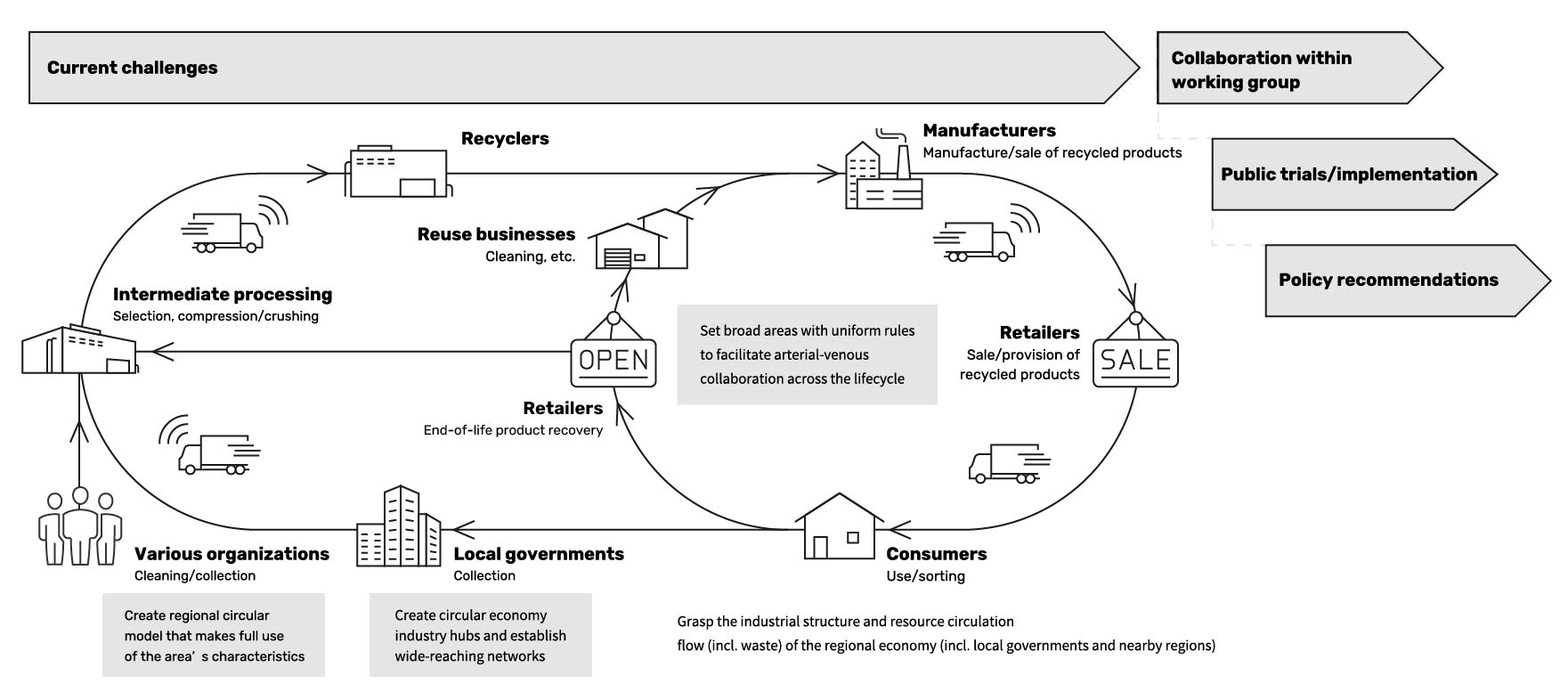
We will implement Policy Making and social implementation regarding the measures necessary to realize a decarbonized, low-environmental-impact regional circulation model, as well as mechanisms that promote behavioral changes among businesses and consumers.
Activities
One of the major directions of the government’s resource circulation strategy is “creating sustainable regions utilizing local resources and developing advanced model cases.” In this working group, to achieve our objectives, we will use the Yokosuka and Miura Peninsula area as our field and refer to examples of regional circulation models both in Japan and abroad. We will create regional circulation models that include modal shifts, small-scale in-store collection, and other initiatives that lead to the creation of new industries, corporate attraction, and tourism promotion. We are currently organizing issues considered to be challenges in creating regional circulation models and will conduct a survey (to re-identify, reconfirm, and solicit solutions to these challenges) for all members of the Resource Recycling Council. After compiling the results, we will reconsider the necessary measures and regional resource circulation models, and implement Policy Making to relevant government agencies, including the Ministry of the Environment and the Ministry of Economy, Trade and Industry. In addition, we will utilize subsidies to carry out social implementation projects in the Yokosuka and Miura Peninsula area.
Group 3
Building a framework for a Japanese standard DPP that revitalizes the recycled material market and creating advanced use cases
Purpose
We will create a sustainable framework by connecting DPP (Digital Product Passport) to the enhancement of Japan's competitiveness.
Activities
In this working group, we will invite corporations with applications related to DPP, organizations that promote data collaboration among companies, and experts leading Japan's standardization efforts. The group aims to leverage DPP to strengthen Japan's competitiveness and create a sustainable framework by advancing various discussions and demonstration experiments. With an eye toward collaboration with SIP and Circular Partners, which lead DPP discussions in Japan, we aim to significantly advance DPP utilization in the country.
(Specific Step Proposal)
- 1.Envision a sustainable state based on preceding European cases and Japanese initiatives led by government agencies
- 2.Consider the boundaries and collaboration between publicly driven platforms (cooperative areas) led by government agencies and each company's applications (competitive areas)
- 3.Centering on companies providing applications, discuss the feasibility of DPP as a business
- 4.Based on hypotheses, demonstrate the cycle in DPP utilization
Group 4
Promotion of initiatives for the practical application of carbon recycling products through carbon circulation
Purpose
Aiming for the early practical application of carbon recycling products through carbon circulation, we will pursue widespread adoption in partnership with industry, government, and academia, create carbon credits by evaluating environmental value, and undertake Policy Making and social implementation to promote inter-industry collaboration.
Activities
The government has indicated that to establish an ecosystem for carbon recycling, it is essential for industry, government, and academia to unite in creating and nurturing the next generation of leaders. To achieve this objective, this working group will accelerate cross-industry collaboration. We will work alongside stakeholders throughout the carbon recycling value chain—including operators engaged in carbon recycling research and technological development, businesses manufacturing and selling carbon recycled products, CO₂ emitters, and CO₂ users—to conduct social demonstration and implementation projects leveraging subsidies and grants. Furthermore, to promote the widespread adoption of carbon recycled products, we will evaluate business models that generate carbon credits and submit policy recommendations to relevant government ministries and agencies, including the Ministry of the Environment (MOE) and the Ministry of Economy, Trade and Industry (METI).
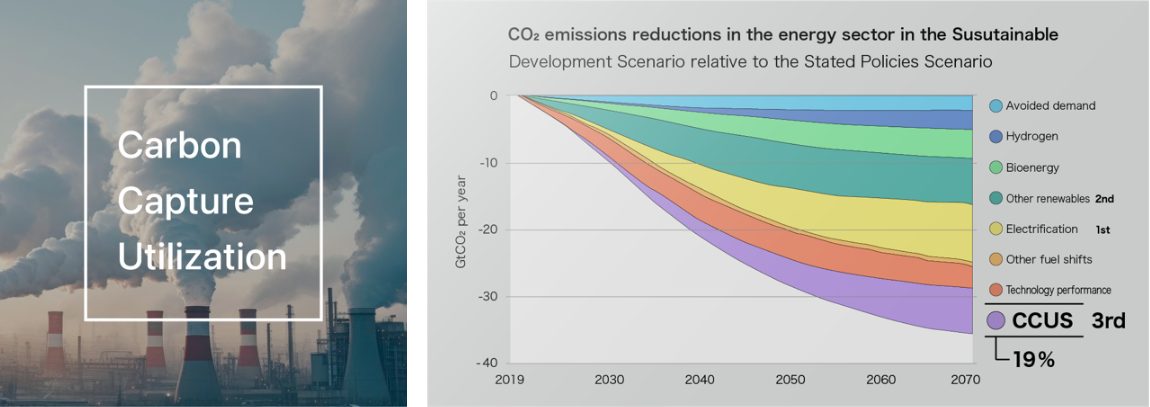
※Reference: Source: IEA “Energy Technology Perspectives 2020”
According to IEA forecasts, of the CO₂ emissions from energy sources, the reduction contribution expected from CCUS (Carbon Capture, Utilization, Storage), including carbon recycling technologies, is about 19%, ranking in the top three.